
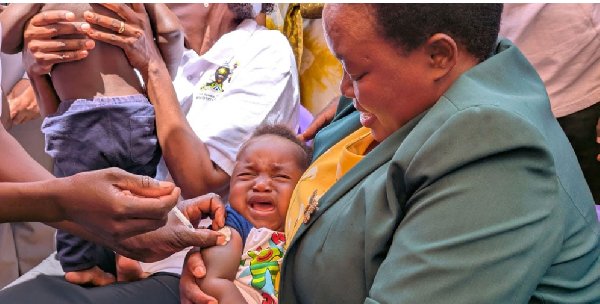
 Prime Minister Robinah Nabbanja holds a baby at the launch of the malaria vaccination exercise Prime Minister Robinah Nabbanja holds a baby at the launch of the malaria vaccination exercise |
KAMPALA, Dec 8 (NNN-AGENCIES) — Uganda’s ambitious malaria eradication efforts are facing setbacks as a low turnout for the newly introduced R21 malaria vaccine threatens the country’s 2030 elimination target.
The government, in partnership with GAVI, distributed 2,278,000 doses of the vaccine to children aged 6 to 18 months in 105 high-burden districts.
But malaria remains the leading cause of illness and death in Uganda, especially among children under five and pregnant women.
Dr Myers Lugemwa, head of the malaria control programme at the Ministry of Health, attributed the declining uptake to parental hesitancy and lack of awareness.
“When we started off in April, we almost scored 80 percent of the targeted population for the first dose. The second dose in May was at 60 percent, while the third dose is coming low compared to what was expected because, having started with 80 percent, we should have maintained with other doses,” he said.
Dr Lugemwa expressed concern over districts in North Buganda, Busoga, and Acholi, where vaccination rates remain below 30 percent despite high malaria mortality.
“It is unfortunate that the cost, value, and its efficacy, which it were part of the other routine vaccines, having taken us 50 years to discover, was to prevent the serious forms of severe malaria, including anaemia, kidney failure, and loss of limbs, among others,” he said.
Uganda records the third-highest number of malaria cases worldwide, after Nigeria and the Democratic Republic of Congo, and ranks eighth in malaria deaths.
Every day, about 16 people die from malaria, 10 of them children under five, according to official data.
During the rollout ceremony, Health Minister Dr Jane Ruth Aceng emphasised that the vaccine works alongside other preventive measures.
“This vaccine prevents severe malaria and morbidity. It’s not true that you will never get malaria again—that’s why we don’t use it in isolation. We use it alongside other preventive measures. We will not have severe malaria or death, which has been the major challenge,” she said.
Dr Lugemwa warned that the under-use of the vaccine, which costs about Shs40,000 per dose, jeopardises both the health ministry and its funders, despite Shs33 billion having been invested to combat malaria.
Among districts with the highest malaria deaths are Hoima (135), Mbale (107), Nebbi (104), Kabale (94), Kampala (92), and Jinja (77).
Regional contributions to malaria mortality include Tooro (12 percent), Busoga (11 percent), and Bunyoro (11 percent), with smaller shares in Kigezi (1 percent) and Kampala (3 percent).
Uganda became the 19th country globally to introduce the malaria vaccine and is undertaking the largest rollout worldwide.
Officials stress that consistent use of the vaccine, alongside mosquito control measures, is essential to curb malaria deaths. — NNN-AGENCIES