
 |
WASHINGTON, Dec 4 (NNN-AGENCIES) — Kenya’s President William Ruto is among the leaders invited to Washington to witness the Thursday (Dec 4) signing of a peace agreement between the Democratic Republic of Congo and Rwanda, reflecting America intends to rope in more regional partners in the deal.
Washington had, in fact, invited a wider pool of African leaders, including African Union Commission Chairperson Mahmoud Youssouf, Angola’s President and Chair of the African Union, Joao Lourenço, Burundi’s Evariste Ndayishimiye, Tanzania’s Samia Suluhu Hassan and Yoweri Museveni of Uganda.
The leaders are to witness the deal signing, but they are also invested in the conflict because they host refugees from Congo, have previously sent troops there, or are interested because of a peace deal protects business ties.
The African Union had tried to consolidate the Congo peace processes before Donald Trump’s mediation roped in Qatar. The AU will now be more of a witness to the peace agreement.
By Tuesday afternoon, diplomatic sources indicated that Burundi and Kenya had confirmed attendance, while the AUC chief, Mahmoud, was also expected in Washington.
Tanzania was expected to send a representative, as was Angola.
President Ruto was expected in Washington on Wednesday, according to a draft itinerary seen by The EastAfrican.
Trump’s invitation of Ruto is both a reflection of the need for neighbours’ participation, but also about the role of countries previously accused of meddling in the conflict can play in influencing parties to sue for peace.
For the past two years, Ruto and Tshisekedi have been at loggerheads, with Kinshasa accusing Nairobi of fomenting the conflict in eastern DRC by providing the M23/Congo River Alliance rebels with a platform to play political games.
Nairobi refuted the accusations but also refused to deport the alleged rebels, some of whom had been sentenced to death in Kinshasa.
In turn, Kinshasa refused to accredit Kenyan diplomats, and months later, protesters vandalised embassy premises in Kinshasa.
On Monday, the White House said the deal signing will be on Thursday for what it was called a “historic peace and economic agreement,” but provided little else on guarantors.
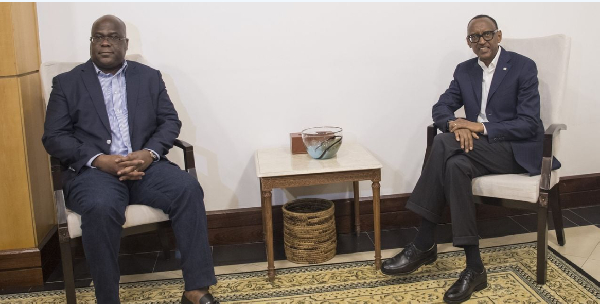
White House Press Secretary Karoline Leavitt told reporters in Washington that both DR Congo’s President Felix Tshisekedi and Rwandan counterpart “ratify a peace accord with Rwanda.”
It would be their first physical meeting them since March when they met them under the mediation of Qatar Emir Sheikh Tamim bin Hammad.
Sheikh Hammad was influential as a mediator between the DRC and M23 rebels and in having both sides agree to the deal, and even accepting to sign. Last week, he travelled to Kigali and Kinshasa to separately meet these leaders.
But Qatar was also supportive of the idea of having neighbours take part, seeing the complexity of the Congo conflict as well as the fact that these countries had previously indicated they needed to have a role.
Kenya, Uganda, and Tanzania have commercial interests in the DRC and have hosted refugees from there.
In the past, Kenya and Uganda sent troops under the East African Community Regional Force (EACRF), a regional military mission that was meant to pacify the eastern DRC and allow political dialogue.
Kinshasa later accused the Kenya-led EACRF of taking sides and ejected them. When the Southern Africa Development Community military mission (SAMIDRC) followed last year in January, it failed and was humiliated on the battlefield by M23. At the time, Kenya accused Kinshasa of shifting goalposts by demanding only peace bids and mediators that favoured the DRC.
In a media interview earlier in January this year, President Ruto said the Congo conflict wouldn’t be solved without involving all Congolese stakeholders.
“Engagement, dialogue, and consultations are the only viable way out of the situation in DRC,” he said after a meeting with African Union officials. In May 2024, Ruto had told The Africa Report, that the conflict in eastern DRC was “a Congolese problem.”
Burundi’s participation was, however, another added dimension. For some time now, Burundi and Rwanda have bickered over support for rebels seeking to destabilise each side.
Burundi was also a participant in the infamous SAMIDRC mission by SADC and had sent troops to fight the M23 alongside the Congolese army (FARDC), while fighting allegations, it had backed the FDLR rebels which Rwanda accuses of emerging out of the remnants of 1994 Rwanda genocidaires while hiding among the Rwanda refugees in Congo. Yet Burundi and Rwanda host each other’s refugees and are culturally related.
Meanwhile, Rwanda’s President Paul Kagame said that while he was willing to sign the deal, he hoped it wouldn’t open a new window for blame games.
“It is not just about a trip to Washington, but about making steps towards an agreement that will start the process that will bring peace to our region and our countries,” Kagame said last week.
In June, the foreign ministers of both Rwanda and Congo signed an initial peace deal, providing for a ceasefire and humanitarian access, as well as framework of negotiations and gave timelines to negotiate a final document.
Kinshasa later accused Rwanda of supporting M23 to violate the deal, accusations Kigali rejected.
The US is modelling the agreement on the economic promise: seeking to entice parties to invest in the natural resources and dissuade them from war.
But it will be interesting how both M23 and the Congolese government handles political prisoner exchanges and shares of revenues from the minerals in the eastern DRC regions currently under the control of M23 since March. — NNN-AGENCIES